
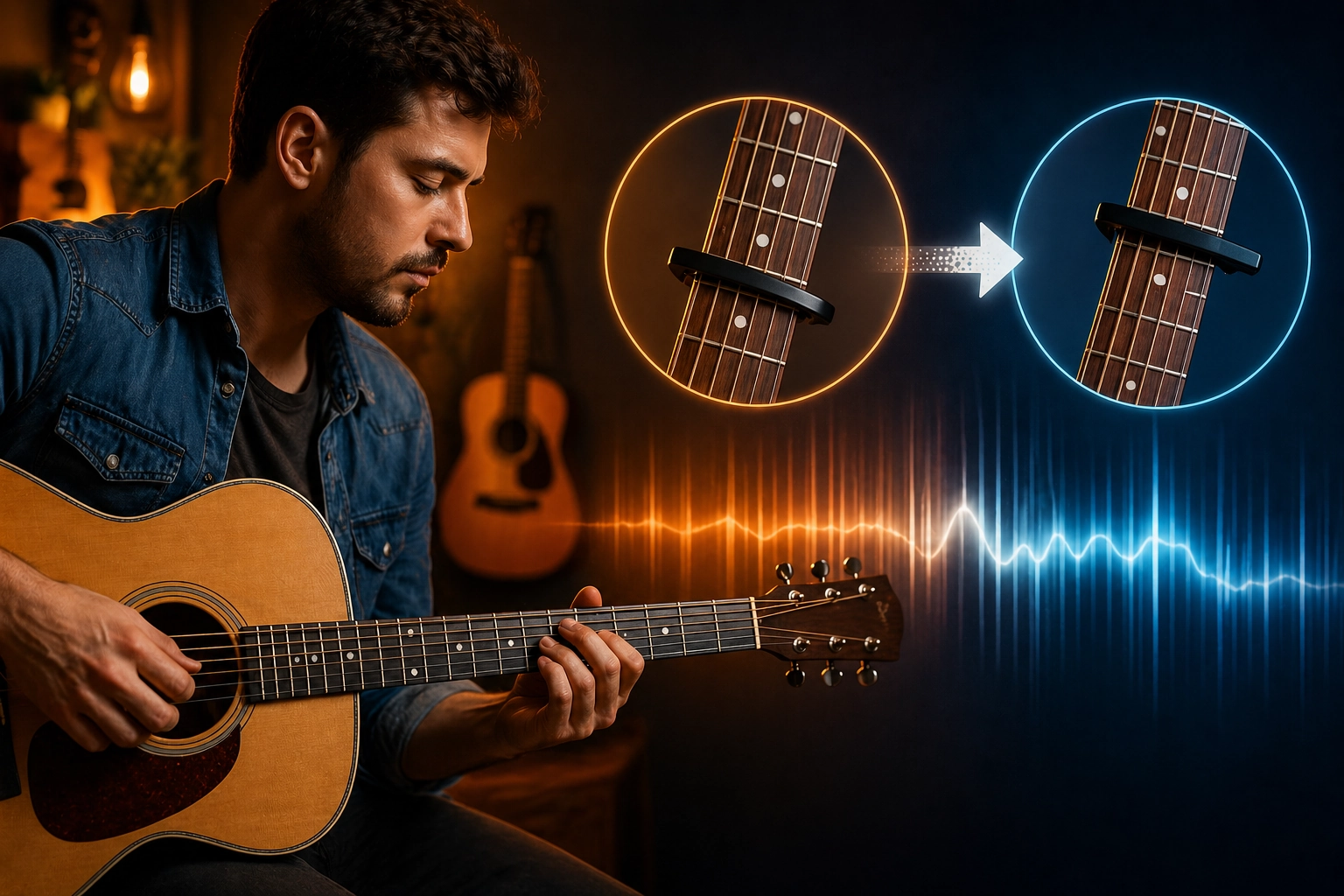
Why the Key Matters for Your Voice
You found the perfect song. The chords are online, the lyrics are ready — but the moment you start singing, something feels off. Your voice strains on the high notes, or the melody sits so low it barely comes out.
This isn't a problem with your voice. It's a problem with the key.
Every song is written in a specific key, and every singer has a specific range — the span of notes they can sing comfortably. When those two things don't line up, the song feels wrong no matter how well you play it.
The goal isn't to force your voice into the song's key. It's to move the song into your key.
The good news: changing the key of a song is completely normal. Professional musicians do it all the time. And with the right tool, it takes less than 10 seconds — even if you have zero music theory background.
What Does Transposing Actually Mean?
Transposing means shifting all the chords in a song up or down by the same number of steps, so the whole thing moves to a higher or lower pitch.
Think of it like an elevator: the entire song rides up or down together. The melody, the chord progressions, the feel — all of it stays intact. Only the pitch changes.
For example, if a song is in the key of G and you transpose it up two steps, every chord shifts: G becomes A, C becomes D, D becomes E, and so on. The song sounds identical — just higher.
- Transpose up (+) to raise the pitch — useful if the song feels too low for your voice
- Transpose down (−) to lower the pitch — useful if the song is too high
- Each step is called a semitone — there are 12 semitones in one octave
You don't need to understand any of that theory to use it. The only thing you need to know is: does the song feel too high or too low? Then move it in the right direction and stop when it feels right.
Step 1: Find Your Comfortable Range
Before you can pick the right key, you need a rough sense of where your voice sits. You don't need to know technical terms like "tenor" or "alto" — just two things:
- 1The highest note you can sing without straining or going falsetto
- 2The lowest note you can sing without your voice getting thin or disappearing
Here's the simplest way to find it: hum along to the song as it's originally recorded. Notice where your voice starts to feel uncomfortable. Is it reaching up too hard for the high parts? Or does the melody feel so low that it's almost a mumble?
That discomfort is your signal. It tells you which direction you need to move the key.
- Voice strains on high notes → transpose the song down
- Voice feels too low or thin → transpose the song up
- Voice feels comfortable throughout → the original key already works for you
Most people find their sweet spot after adjusting by just 1 to 3 semitones in either direction. Occasionally a song needs a bigger shift — 4 or 5 steps — but that's less common.
Step 2: Pick the Right Key
Now comes the part where most beginners expect it to get complicated. It doesn't have to be.
The simplest method: transpose by one step at a time and sing along after each adjustment. Stop when the song feels natural in your voice — when you're not reaching up or straining down.
There's no "wrong" key. The right key is the one you can sing in comfortably. Full stop.
If it feels good when you sing it, you've found your key.
A few things to keep in mind as you search:
- Your vocal range might be wider than you think — explore a few different keys before settling
- Try singing the chorus, not just the verse — choruses are usually the highest part of the song
- Warm your voice up first; your range is slightly narrower when cold
- If you play guitar, some keys are easier to play than others (open-chord keys like G, C, D, E, A are usually the most beginner-friendly)
That last point matters: you might find two keys that both feel comfortable for your voice. In that case, choose whichever one gives you easier chord shapes on the guitar. Tools like TransposeChord show you the resulting chords in real time so you can see what you're working with before you commit.
Quick tip
Don't want to figure out the math yourself? Paste your chords and shift keys instantly:
Use TransposeChord →Capo vs. Transposing Chords
If you play guitar, you've probably heard of a capo — a small clamp that raises the pitch of all the strings by clipping onto a fret. Both a capo and transposing achieve a similar goal (shifting pitch), but they work differently.
Here's a quick comparison:
| Capo | Transpose Chords | |
|---|---|---|
| Changes pitch of guitar | ✓ | ✓ |
| Works for any instrument | — | ✓ |
| Chord shapes stay the same | ✓ | — |
| Can shift down (lower key) | — | ✓ |
| No extra gear needed | — | ✓ |
| Works for singers without a guitar | — | ✓ |
A capo is great when you want to raise the pitch while keeping the same chord shapes your fingers already know. If a song uses G, C, and D and you want it higher, clipping a capo on fret 2 gives you the same shapes but two semitones up.
But a capo has limits: it can only raise pitch, not lower it. And if you don't have a capo, or you need to coordinate with other musicians or instruments, transposing the actual chords is more flexible.
For singers specifically, transposing is usually the better long-term skill to develop — because it works everywhere, not just on guitar.
If you do want to use a capo, our guitar capo chart shows exactly which fret gives you which key, and which positions leave you with easy open chords.
Try It Now (No Theory Needed)
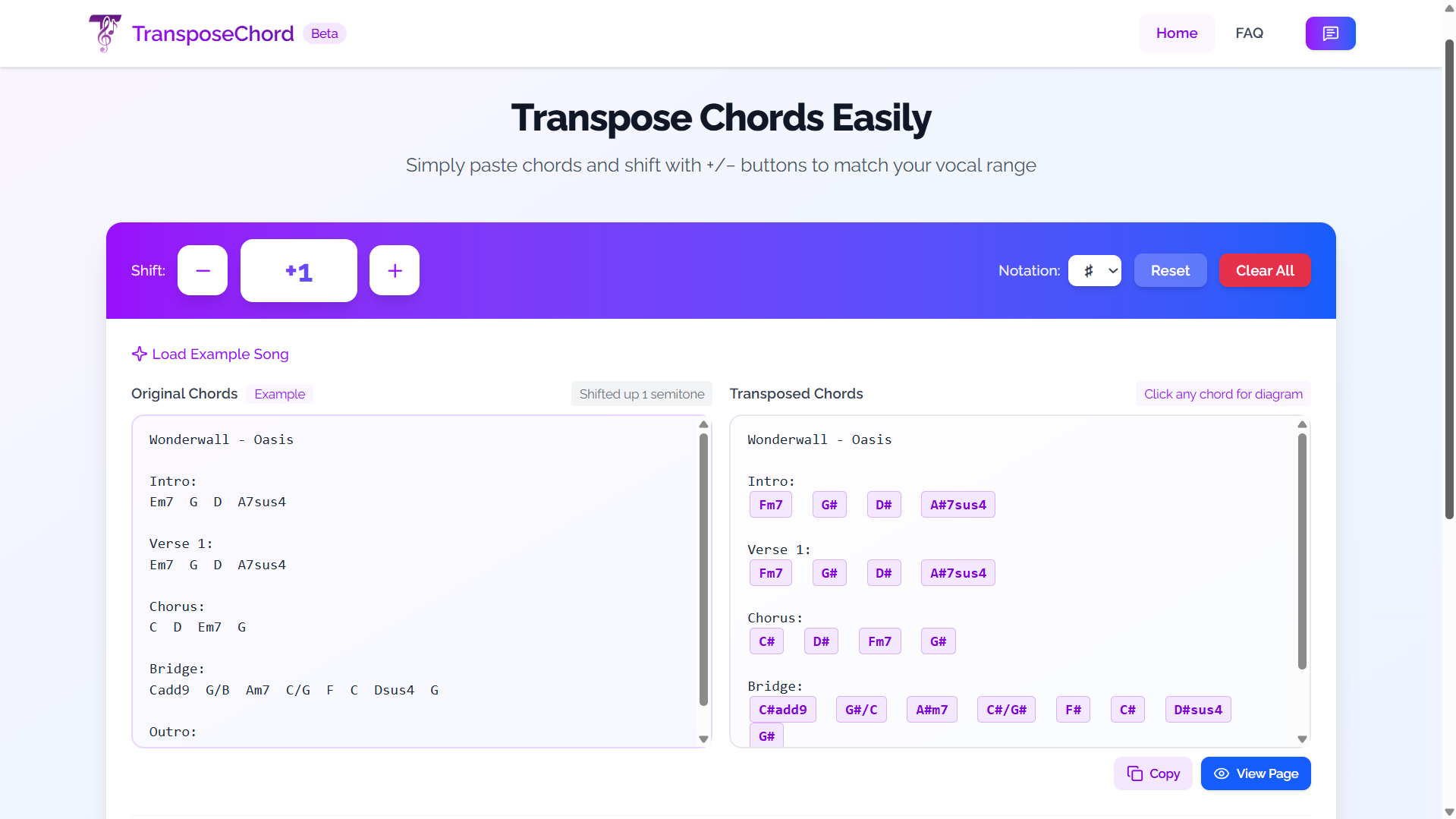
Here's the entire process, start to finish:
- 1Find the chord chart for your song online
- 2Paste the chords into TransposeChord
- 3Sing along with the song in the original key
- 4If it's too high, press − once. If it's too low, press + once
- 5Sing the chorus again. Repeat until it feels right
- 6Play from the final chord sheet
That's genuinely it. No music theory, no calculating intervals, no memorizing key signatures. The tool handles all of that automatically — you just listen to your own voice and follow what feels comfortable.
Once you've found your key, you'll also see interactive guitar chord diagrams for every chord in the new key, so you know exactly where to place your fingers even if some chords are unfamiliar shapes.
Most people find their key in under two minutes the first time. After a few songs, you'll start to recognize patterns and get there even faster.
Free tool
Find your key in under 10 seconds
Paste your chords, hit + or −, and sing comfortably. No theory. No guesswork.
transposechord.com →