What a Capo Actually Does
You found the chords for a song, and the first one is B♭. Then E♭. Then Cm. Your hand already hurts just looking at it.
This is the moment most guitarists reach for a capo — and the moment most of them guess which fret to use.
A capo is a clamp that presses down every string at one fret. That's the whole mechanism. It turns that fret into your new nut, so every shape you play sounds higher than it looks.
A capo doesn't change what your fingers do. It changes what your fingers mean.
Put a capo on fret 2 and play a G shape, and the guitar sounds an A. Your fingers are still in the G shape you learned on day one. The note coming out is a different chord entirely.
That's the trick, and it's why capos are worth understanding: one fret up equals one semitone up. Two frets, two semitones. Everything else is just counting.
The Guitar Capo Chart
Here's the counting done for you. This capo chart covers every fret from open to 9, and the eight chord shapes you're most likely to be holding.
Find your capo fret on the left, then read across to the shape you're playing.Tap a capo position to see what each shape sounds like.
Capo on fret 2 — each shape sounds as:
- C shapeD
- A shapeB
- G shapeA
- E shapeF#
- D shapeE
- Am shapeBm
- Em shapeF#m
- Dm shapeEm
| Capo | Chord shape you play | |||||||
|---|---|---|---|---|---|---|---|---|
| C | A | G | E | D | Am | Em | Dm | |
| No capo | C | A | G | E | D | Am | Em | Dm |
| Fret 1 | C# | A# | G# | F | D# | A#m | Fm | D#m |
| Fret 2 | D | B | A | F# | E | Bm | F#m | Em |
| Fret 3 | D# | C | A# | G | F | Cm | Gm | Fm |
| Fret 4 | E | C# | B | G# | F# | C#m | G#m | F#m |
| Fret 5 | F | D | C | A | G | Dm | Am | Gm |
| Fret 6 | F# | D# | C# | A# | G# | D#m | A#m | G#m |
| Fret 7 | G | E | D | B | A | Em | Bm | Am |
| Fret 8 | G# | F | D# | C | A# | Fm | Cm | A#m |
| Fret 9 | A | F# | E | C# | B | F#m | C#m | Bm |
Every cell is the chord that actually sounds when you play that shape at that capo position.
Bookmark this one. It answers the two questions that come up constantly: what key am I actually in right now, and what capo position gets me to the key I want.
How to Read the Chart
Two columns of information, one answer. Find the row for where your capo is, then look at the column for the shape your fingers are making. The cell where they meet is the chord that actually comes out of the guitar.
A few worked examples:
- Capo 2, playing a G shape → sounds like A. So a song "in G with capo 2" is really in the key of A.
- Capo 3, playing a C shape → sounds like D♯/E♭.
- Capo 5, playing an Em shape → sounds like Am.
- Capo 4, playing a D shape → sounds like F♯/G♭ — a key almost nobody wants to play in directly.
That last example is the point of the whole exercise. F♯ major is a nightmare of barre chords. F♯ major played as D shapes with a capo on 4 is a song you already know how to play.
The chart also explains something that confuses a lot of beginners: when a chord sheet says "Capo 3" at the top and then lists G, C, D, and Em, those letters are the shapes you play, not the key the song is in. The song is in B♭. You just never have to think about B♭.
What Capo Do I Need for This Key?
Most capo charts only work in one direction — they tell you where you end up. The more useful question is the reverse one: I need this song to be in a specific key. Where does the capo go?
Pick your key below and you'll get every capo position that gets you there, with the open-chord options flagged.
Lowest open-chord position
Put your capo on fret 1 and play everything in A. It sounds in A♯ / B♭.
- No capoplay in A# / Bb
- Fret 1play in AOpen chords
- Fret 2play in G# / Ab
- Fret 3play in GOpen chords
- Fret 4play in F# / Gb
- Fret 5play in F / F
- Fret 6play in EOpen chords
- Fret 7play in D# / Eb
The flagged rows are the ones worth taking. C, G, D, A, and E are the five keys that give you open chord shapes on a standard-tuned guitar — the shapes you can play without barring anything.
Any key you want is reachable from one of those five within a few frets. That's the entire reason capos exist.
Quick tip
No capo on you? Paste the chords and shift the key directly — same result, no gear:
Use TransposeChord →The Capo Positions You'll Actually Use
In practice, four positions cover most of what you'll ever need:
- Capo 2 — the most common position in popular music. G shapes give you A, C shapes give you D, D shapes give you E. It nudges a song up just enough without thinning out the tone.
- Capo 3 — the B♭ and E♭ solution. G shapes sound in B♭, C shapes sound in E♭. This single position unlocks most horn-friendly keys that guitars normally hate.
- Capo 4 — gets you into E and A♭ territory. Useful for singers who need a real lift, and the guitar still sounds full here.
- Capo 5 — the same pitch as playing from the 5th fret. C shapes sound in F, which is how a lot of players avoid the F barre chord entirely.
Above fret 7 the frets get cramped, the strings tighten, and the guitar starts sounding closer to a banjo than a guitar. It works, but it changes the character of the instrument. If you need to go higher than 7, you probably want to transpose the chords instead.
Using a Capo to Match Your Voice
If you're playing and singing at the same time, the capo isn't really about chord shapes — it's about your vocal range.
The method is simple, and it doesn't require you to know a single note name:
- 1Play the song open, with no capo, and sing the chorus — not the verse. The chorus is almost always the highest part.
- 2If it feels low or mumbly, move the capo up one fret and sing it again.
- 3Keep going one fret at a time until your voice sits comfortably.
- 4Stop the moment it feels natural. That fret is your key.
Most people land somewhere between fret 1 and fret 4. If you get past 7 and it's still too low, the song was written for a lower voice than yours and a capo won't fix it — you'd be better off transposing the chords up and playing new shapes.
We go deeper on the vocal side of this in how to change the key of any song for your voice.
When a Capo Is the Wrong Answer
Capo charts rarely mention this part, so here it is plainly. A capo has four real limitations:
- It only goes up. A capo shortens the strings, so it can only raise pitch. If a song is too high for you, no capo position will help — you have to transpose the chords down.
- It costs you your low end. Capo on 5 and your lowest available note is an A, not an E. Songs that lean on deep open bass notes lose weight fast.
- It only helps you. A capo changes your guitar. It does nothing for the piano player, the bassist, or the second guitarist reading the same chart.
- You have to actually have one. A capo is the one accessory that is always in the other bag.
In all four cases the answer is the same: transpose the chords themselves. Instead of moving the guitar, you move the song — every chord shifts by the same number of semitones and you play the new letters as written.
That works on any instrument, in either direction, with no gear. It's the more flexible skill, and it's the one worth building.
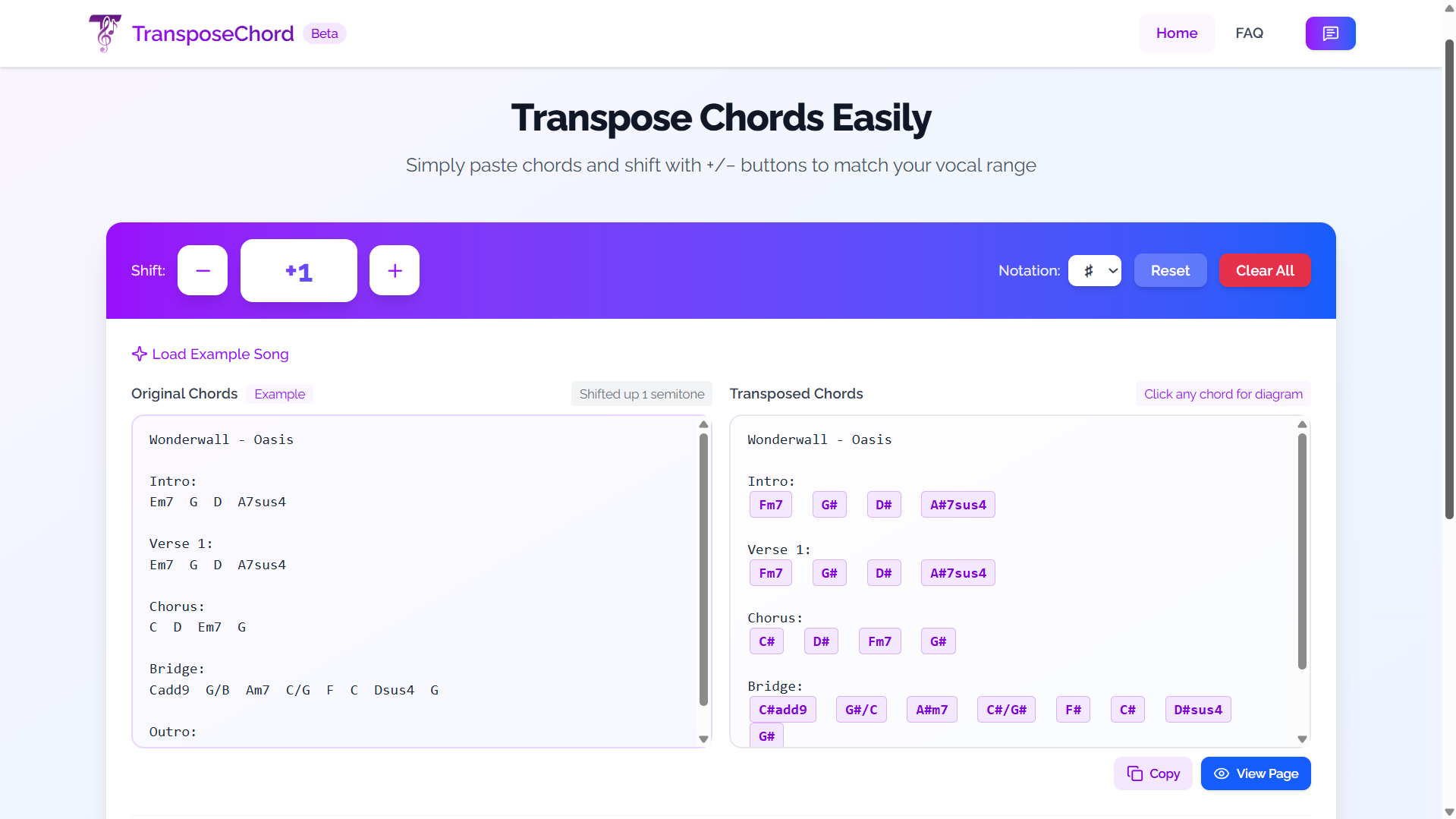
The honest summary: use a capo when you want to go up and keep the shapes you know. Transpose when you need to go down, when other musicians are involved, or when the capo is at home on the kitchen table.
Capo Questions, Answered
What key is capo 2 in?
A capo doesn’t have a key of its own — it raises whatever you play by that many semitones. Capo 2 playing G shapes sounds in A. Capo 2 playing C shapes sounds in D. Capo 2 playing D shapes sounds in E. The shape you play decides the key; the capo just moves it up two frets.
What capo do I need to play in the key of B♭?
Capo 1 and play A shapes, or capo 3 and play G shapes — both sound in B♭. Capo 1 keeps more of the guitar’s low end; capo 3 puts you in the very familiar G, C, D and Em family. Either is a normal choice.
Can a capo lower the key of a song?
No. A capo shortens the strings, so it can only raise pitch. If a song is too high for your voice, a capo can’t help — you need to transpose the chords down instead.
Does a capo make guitar easier?
It can. A capo lets you play a hard key using easy open shapes — for example, playing in B♭ with familiar G shapes at fret 3 instead of fighting through B♭ and E♭ barre chords. It doesn’t make you play better, but it removes barre chords from a lot of songs.
How high up the neck can you put a capo?
Most players stay at fret 7 or below. Past that the frets get narrow, string tension changes, and the guitar starts to sound thin and banjo-like. If you need to go higher than 7, transposing the chords is usually the better answer.
Should I use a capo or transpose the chords?
Use a capo when you want to raise the key on guitar and keep the shapes your fingers already know. Transpose the chords when you need to go lower, when you’re playing with other instruments, or when you don’t have a capo with you.
Free tool
When a capo can't reach it, transpose it
Paste your chords, shift the key up or down, and see the fingering for every chord you land on.
transposechord.com →