What a Key Means on Guitar
Every beginner finds this out the same way. You look up the chords to a song you love, you start playing, and three chords in there's a B♭ waiting for you. The song stops there.
Here's what nobody tells you in that moment: the difficulty isn't in the song. It's in the key.
A key is just the family of chords a song is built from. Pick a starting note and the key hands you six chords that sound good together — three major, three minor. Songs in the key of G use G, C, D and Em over and over. Songs in the key of B♭ use B♭, E♭, F and Gm.
Musically those two families are identical. Same shape, same relationships, same emotional weight. The only real difference is pitch.
On guitar, some keys hand you open chords and others hand you barre chords. That one accident of tuning decides which songs a beginner can actually play.
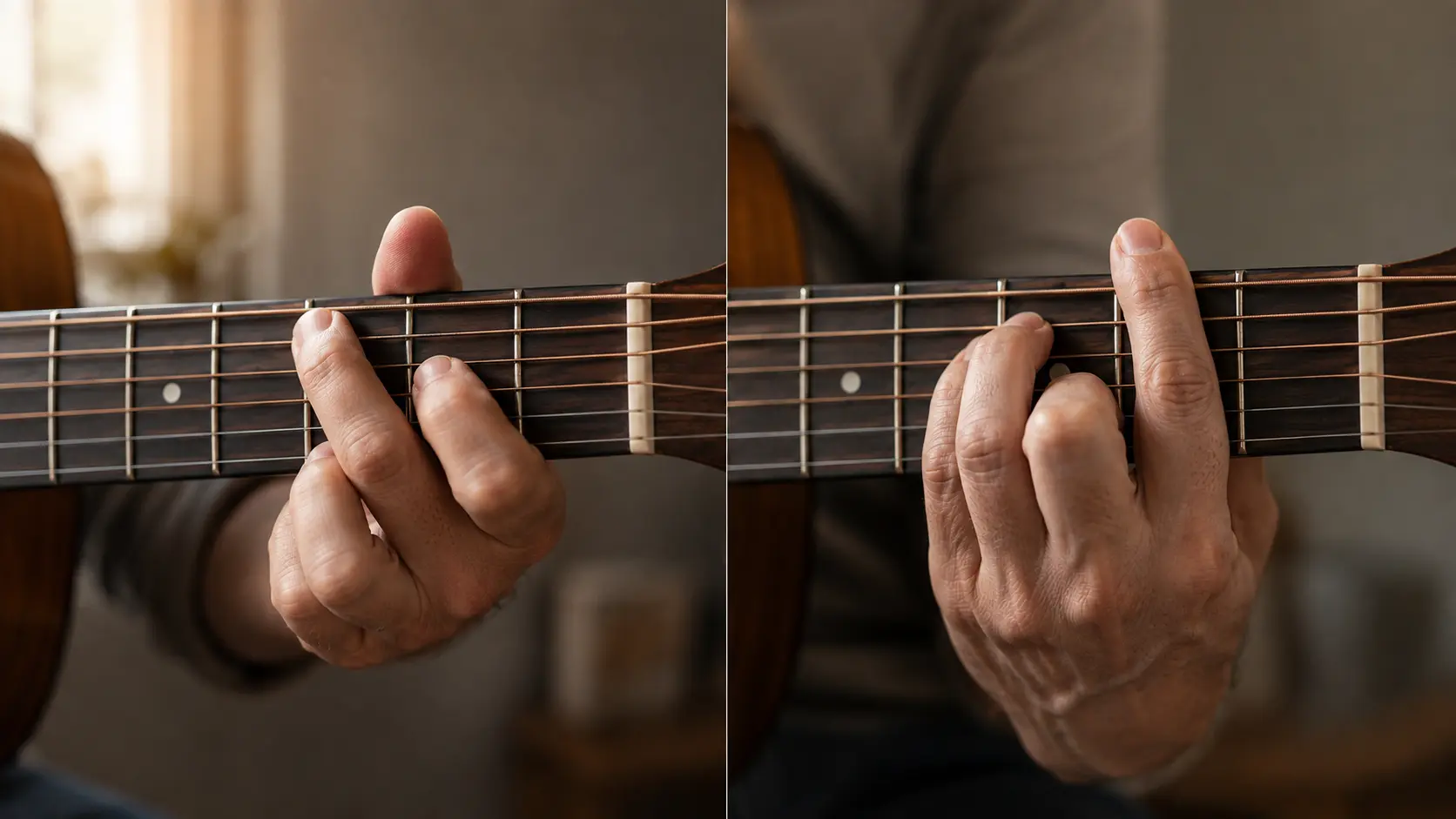
The guitar is tuned E–A–D–G–B–E. That tuning lets certain shapes ring out using open strings — strings you don't have to press at all. Other shapes have no open strings available, so you have to lay one finger flat across the whole neck and press every string at once. That's a barre chord, and it's where most beginners stall.
So the useful question isn't really "what are the basic guitar keys?" It's which keys let me use open strings, and how do I get a song into one of them? Both halves of that have exact answers.
All 12 Keys, Ranked by Difficulty
Below is every key on the guitar, sorted by how many of its chords force a barre. These counts aren't opinions — they're read straight from the fingering data behind our chord diagrams. A chord counts as a barre when it has no open strings left to ring.
Start with the four-chord view. Those four chords — the I, IV, V and vi — are what the overwhelming majority of pop, folk, worship and country songs are actually built from.
| Key | I – IV – V – vi | Barres |
|---|---|---|
| G | GCDEm | 0 |
| C | CFGAm | 1 |
| D | DGABm | 1 |
| A | ADEF#m | 1 |
| F | FA#CDm | 2 |
| E | EABC#m | 2 |
| B | BEF#G#m | 3 |
| A# | A#D#FGm | 4 |
| C# | C#F#G#A#m | 4 |
| D# | D#G#A#Cm | 4 |
| F# | F#BC#D#m | 4 |
| G# | G#C#D#Fm | 4 |
Chords marked in orange have no open strings left to ring — every one of them needs a barre. Counts are read from the same fingering data the transposer uses to draw its chord diagrams.
One result jumps straight out:
G is the only key on the guitar whose four core chords contain no barre at all.
G, C, D, Em. Four open shapes, and thousands of songs. That's not a coincidence — it's a large part of why so much popular music gets written in G in the first place.
Right behind it, C, D and A each cost exactly one barre chord. And at the bottom, the five sharp and flat keys each demand a barre on all four. Those are the keys built for horns, piano and singers, and they're precisely the keys where guitarists give up.
Switch the table to All 6 and the picture shifts slightly: C becomes the cleanest key overall with F as its only barre, while G picks up a second problem chord, Bm, as soon as you use the full family.
The Five Basic Keys for Beginners
Five keys carry almost all beginner guitar music: G, C, D, A and E. Here's what each one actually costs you.
- G — G, C, D, Em. Zero barres. The easiest key on the instrument, and the first place to move any song you are struggling with.
- C — C, F, G, Am. One barre: F. The most common key in written music, and F is the single wall standing in the middle of it.
- D — D, G, A, Bm. One barre: Bm. Bright and open-sounding, everywhere in folk and worship, blocked by exactly one chord.
- A — A, D, E, F#m. One barre: F#m. The classic rock and blues key. Big, loud open shapes with one minor chord to solve.
- E — E, A, B, C#m. Two barres: B and C#m. The heaviest-sounding open key, and measurably harder than the other four.
Notice the pattern. Four of the five cost you either nothing or a single chord. Learn those four gatekeepers — F, Bm, F♯m and B — and you have essentially unlocked all of beginner guitar.
The Chords That Block Each Key
Each easy key has one gatekeeper chord. Once you know which one it is, you know exactly what to do about it.
B minor — the one chord standing in the key of D
Bm is probably the most-searched hard chord on the guitar, and the reason is structural. It's the vi chord of D major, one of the most popular keys in folk, worship and singer-songwriter music. Every song in D eventually arrives at Bm.
Two ways through it:
- 1Move the song. Transpose a song in D up five semitones and it lands in G — the Bm becomes Em, an open chord anyone can play. The whole song gets easier, not just that one bar.
- 2Keep the pitch, change the shape. Put a capo on fret 2 and play an Am shape. It sounds as Bm, and your fingers never leave open-chord territory.
Worth saying plainly: Bm is also a genuinely good chord to learn. It's the gateway to every A-shape barre on the neck. Transpose so you can finish the song today, and keep working on Bm on the side.
F — the one chord standing in the key of C
C major is the cleanest key in written music and the first one most people learn. Then the IV chord turns up and it's F, the chord that has ended more guitar journeys than any other.
Transposing a song in C up seven semitones puts it in G, where that IV chord becomes an open C. Or capo 5 and play G shapes to keep the original pitch exactly.
F♯ minor — the one chord standing in the key of A
A major gives you three big ringing open chords — A, D and E — and then asks for F♯m. Transposing down two semitones to G turns it into Em. Capo 2 with G shapes gets you the same sound with the same easy grip.
B major — the chord that makes E hard
E is the only one of the five open keys that costs two barres, and B is the main culprit as its V chord. Capo 2 and play an A shape, or capo 4 and play a G shape — both sound as B. In a blues or rock context, B7 is also a widely used open substitute that keeps the same function with a far easier grip.
Quick tip
Paste a whole chord sheet into the transposer and shift it. Every chord you land on comes with its fingering diagram, so you can see the barres before you commit to a key:
Use TransposeChord →Find the Easiest Key for Your Song
General rankings only get you so far. Real songs don't use all six chords of a key, and they sometimes borrow one from outside it. The only way to know which key suits your song is to check that song's actual chords.
So do exactly that. Paste any chord chart below and every possible key gets scored by how many barre chords it would leave you holding.
As written
1 barre chord to get through: Bm
Easiest key
Transpose up 5 semitones and you get G, D, Em, C — no barre chords at all. The song changes pitch.
Same pitch, easier shapes
Put a capo on fret 7 and play G, D, Em, C. It sounds in the original key with nothing to barre.
- As isDABmG1
- +1D#A#CmG#4
- +2EBC#mA2
- +3FCDmA#2
- +4F#C#D#mB4
- +5GDEmC0
- +6G#D#FmC#4
- +7AEF#mD1
- +8A#FGmD#4
- +9BF#G#mE3
- +10CGAmF1
- +11C#G#A#mF#4
The example loaded in there is a song in D — a completely ordinary four-chord progression with Bm sitting in the middle of it. Shift it up five semitones and every barre disappears.
Two different answers come out of this widget, and they solve different problems:
- Transpose when you are playing alone, or when the change in pitch is fine — or better, because it suits your voice. The song genuinely moves.
- Capo when the pitch has to stay put: you are playing along to a recording, backing a singer who knows their key, or sitting in with other musicians reading the original chart.
Both routes end in the same place — open chords under your fingers.
The Capo Shortcut: G Shapes Reach Everything
Here's a consequence of the ranking that deserves its own section. G is the only key with zero barre chords in its core, and a capo raises everything you play by one semitone per fret. Put those two facts together and you get a single rule that covers most of the neck:
Play G shapes. Move the capo. You can reach almost any key without barring a single chord.
- Capo 2 with G shapes sounds in A
- Capo 3 with G shapes sounds in B♭ — the horn key guitarists dread
- Capo 4 with G shapes sounds in B
- Capo 5 with G shapes sounds in C
- Capo 7 with G shapes sounds in D
This is why so many chord sheets say "Capo 3" at the top and then list G, C, D and Em underneath. The song is in B♭. You just never have to think about B♭.
The limit here is physical. Past fret 7 the frets get cramped and the guitar starts sounding thin and banjo-like, so a key like E — which would need capo 9 for G shapes — is better reached by transposing, or by using E's own shapes and learning its two barres. Everything from capo 1 to 7 is fair game.
The full position-by-position breakdown lives in our guitar capo chart, including which shapes to use for the keys G can't reach comfortably.
When the Easy Key Fights Your Voice
Now the honest part, because most articles on this topic quietly skip it.
Transposing a song into G because your hands like G can drop it into a range your voice hates. These two constraints pull against each other constantly, and the easiest key on paper is not always the right one.
When they conflict, the order of priority is straightforward:
- 1Find the key that suits your voice first. Sing the chorus — the highest part of the song — and adjust until it sits comfortably. Your voice has a fixed range; your hands do not.
- 2Then use a capo to make that key playable. A capo raises pitch without changing the shapes you hold, so it solves the hand problem without touching the vocal one.
- 3If the capo cannot reach it — because you need to go down rather than up — transpose the chords and accept the barres, or learn the two or three shapes that key demands.
Only trade the vocal key for the easy key when you're playing instrumentally, or when the gap is small enough that nobody notices.
We walk through the vocal side of this properly in how to change the key of any song for your voice.
And one last thing, for anyone who found this page while stuck on a chord. Choosing an easier key isn't cheating, and it isn't permanent. It's how you get to actually play the song this week instead of abandoning it. The barre chords will still be waiting when you're ready for them — and by then you'll have a hundred finished songs behind you instead of a hundred abandoned ones. That's more or less the whole reason this site exists, and the story behind it is this exact discovery, made the slow way.
Key Questions, Answered
What are the basic guitar keys for beginners?
G, C, D, A and E. These five keys are built almost entirely from open chord shapes, which is why nearly every beginner songbook stays inside them. G is the easiest of the five: its I, IV, V and vi chords are G, C, D and Em, and not one of them needs a barre.
What is the easiest key to play on guitar?
G major. Its four core chords — G, C, D and Em — are all open shapes, making it the only key on the guitar where the standard four-chord progression contains no barre chords at all. C major is a close second: F is its only barre.
Which guitar keys are the hardest?
The five sharp and flat keys — C♯/D♭, D♯/E♭, F♯/G♭, G♯/A♭ and A♯/B♭. Each one forces a barre on all four of its core chords. They are common keys for horns, piano and vocalists, which is why guitarists so often reach for a capo or transpose the chart.
How do I make B minor easier on guitar?
Two reliable options. Move the song: transpose a song in D up five semitones and it lands in G, where the Bm becomes an open Em. Or keep the pitch and change the shape: a capo on fret 2 turns an Am shape into a sounding Bm. Bm is the single barre chord standing between the key of D and a fully open song, so it is worth solving rather than avoiding forever.
How do I play B major without a barre?
Capo 2 and play an A shape, or capo 4 and play a G shape — both sound as B. If B is the V chord of a song in E, B7 is also a common open substitute that keeps the same harmonic function with a much easier grip.
Should I avoid barre chords as a beginner?
Avoid them while you are learning songs, not forever. Transposing into an open key lets you actually finish and enjoy a song this week. But barre chords unlock the other seven keys, so keep practising them on the side — the goal is to have the choice, not to be stuck in G.
Does changing the key change how the song sounds?
Yes. Transposing moves the whole song higher or lower in pitch, which affects how it sits against your voice and against a recording. If you need the original pitch but easier shapes, use a capo instead — that keeps the sound identical and only changes what your fingers do.
Free tool
Move any song into a key your hands like
Paste your chords, shift the key, and see the fingering for every chord you land on — barres and all.
transposechord.com →