What D Standard Tuning Is
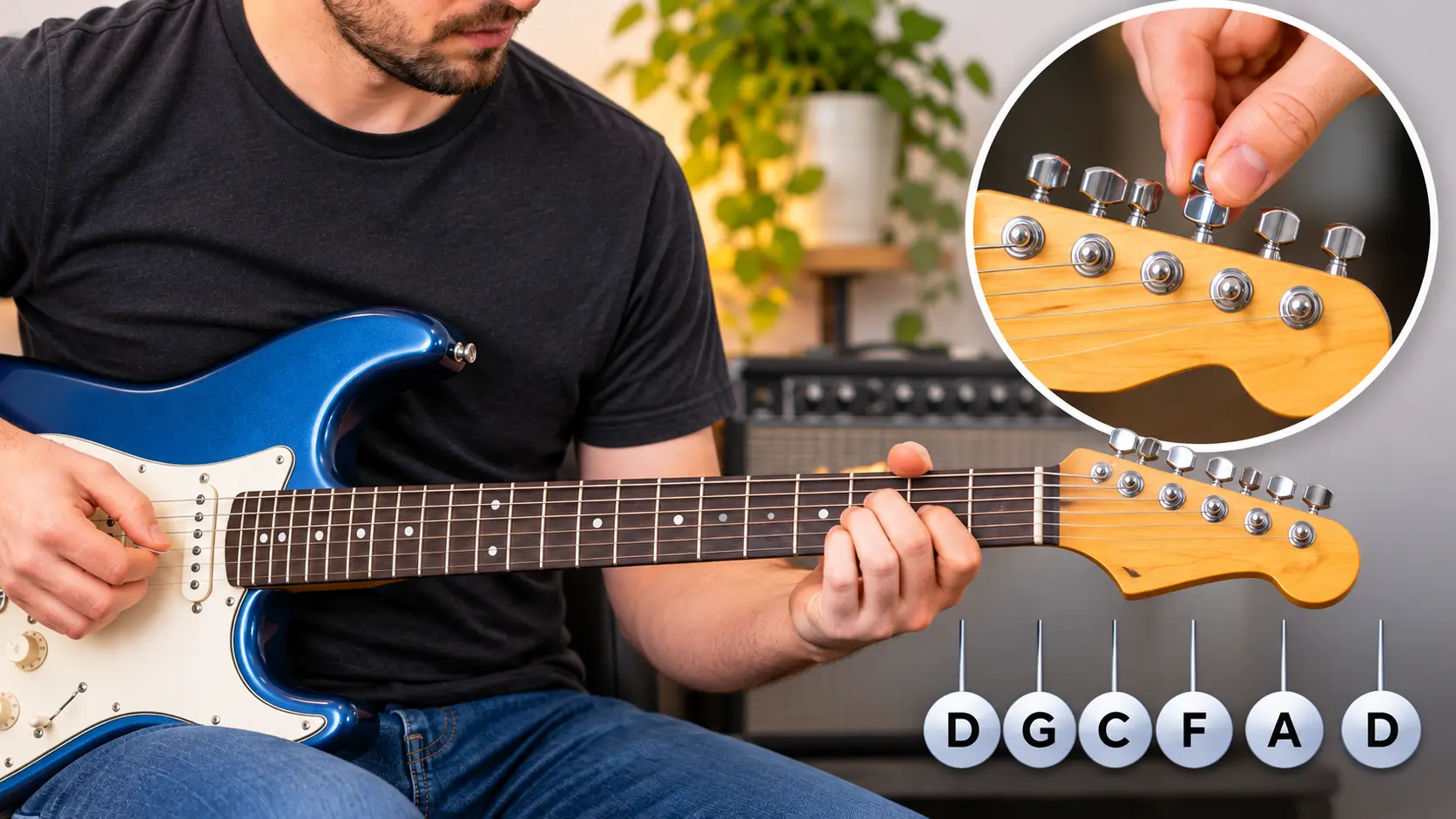
D standard tuning — also called whole step down, full step down, one step down or DGCFAD — lowers all six strings by two semitones. Low to high, the strings become D G C F A D instead of E A D G B E.
Because every string drops by the same amount, the guitar is still in "standard" tuning relative to itself. Every chord shape, scale pattern and riff sits exactly where it always did. Only the pitch changes: everything you play sounds a whole step lower than its name. A G shape plays F. An E shape plays D.
Players tune down a whole step for three reasons:
- A heavier, darker tone. The same chords ring two semitones lower — the reason D standard is everywhere in hard rock, grunge and metal.
- Looser strings. Two semitones less tension makes wide bends and heavy vibrato much easier, though light strings can start to feel floppy.
- The singer. Dropping a song a whole step without learning new chord shapes is often the simplest way to bring a melody into range.
Same shapes, two semitones lower. Every trick in this post follows from that one sentence.
How to Tune Your Guitar to D Standard
Use any chromatic tuner — clip-on, pedal or a phone app. Good news compared with half step down: every D standard note is a natural (no sharps or flats), so your tuner will name each one directly.
- Lower the 6th string (low E) a whole step to D.
- Lower the 5th string (A) a whole step to G.
- Lower the 4th string (D) a whole step to C.
- Lower the 3rd string (G) a whole step to F.
- Lower the 2nd string (B) a whole step to A.
- Lower the 1st string (high E) a whole step to D.
A whole step is a big drop, so three habits matter more than they do for E♭:
- Go a little below each note, then tune up to it. Coming up to pitch takes the slack out of the string and the tuning peg, so it holds instead of creeping flat.
- Go round all six strings two or three times. Losing two semitones of tension on every string lets the neck relax, which pulls the strings you already tuned sharp.
- Expect a looser feel. If the low D flaps or buzzes, the fix is a heavier string set (10s to 11s is a common step), not a harder picking hand.
If you're keeping a guitar in D standard permanently, a quick setup — neck relief and intonation — is worth it after switching to heavier strings.
D Standard vs Drop D vs Drop C
Three tunings with a D in the name or a D on the low string, and they behave very differently. The column that matters is the last one: how far your chords sound below their names.
| Tuning | Strings (low → high) | Compared with standard |
|---|---|---|
| StandardE standardChord names unchanged | E A D G B E | Chord names unchanged |
| Half step downE♭ standardChords sound 1 semitone lower | E♭ A♭ D♭ G♭ B♭ E♭ | Chords sound 1 semitone lower |
| D standardwhole step down, DGCFADChords sound 2 semitones lower | D G C F A D | Chords sound 2 semitones lower |
| Drop Donly the low E dropped to DChord names unchanged | D A D G B E | Chord names unchanged |
| Drop CD standard + low string droppedChords sound 2 semitones lower | C G C F A D | Chords sound 2 semitones lower |
- Drop D changes only the low string. Every chord name on a Drop D sheet is already the chord you hear — no transposing.
- Drop C is D standard with the low string dropped a further whole step. Its top five strings are identical to D standard, so for chord purposes it behaves exactly the same: everything sounds two semitones lower.
- Half step down (E♭) is the halfway house: one semitone instead of two.
Most tuning guides treat these as separate topics. For chord sheets they reduce to one number, and that number is what you transpose by. Our guide to half step down tuning covers the one-semitone case.
Play D Standard Songs in Standard Tuning
Most D standard chord sheets show the shapes the guitarist held, not the pitch you hear. Type them in below to get what the recording actually plays — and every capo position from 0 to 7 that reproduces it on a guitar in standard tuning, with barre chords greyed out.
What the recording actually plays
F Dm Bb C
Easiest way in standard tuning
Capo on fret 3, then play D Bm G A. 1 barre chord — the fewest of any capo position up to 7.
- No capoFDmBbC2 barre
- Capo 1EC#mAB2 barre
- Capo 2EbCmAbBb4 barre
- Capo 3DBmGA1 barre
- Capo 4DbBbmGbAb4 barre
- Capo 5CAmFG1 barre
- Capo 6BG#mEGb3 barre
- Capo 7BbGmEbF4 barre
Grey chords are barre shapes. Every row sounds identical to the recording.
Here's why D standard is friendlier than half step down: two semitones down from the open-chord families lands on other open-chord families. E, A and B shapes become D, G and A. A, D and E become G, C and D. For a lot of D standard songs you don't need a capo at all — just move every chord down two.
Worked Example: "Yesterday"
The most famous D standard song isn't a metal track. Paul McCartney tuned his acoustic down a whole step for "Yesterday" and played it with G-key shapes — so the recording sounds in F. On the Anthology outtake you can hear him tell the session players exactly that: he's playing in G, it'll sound in F.
That's the converter's default example. A chart in G shapes — G, Em, C, D — sounds as F, Dm, B♭ and C. In standard tuning you have three honest choices:
- Play F, Dm, B♭ and C as written. Exact pitch, but F and B♭ are barre chords.
- Capo 3 and play D-family shapes, or capo 5 and play C-family shapes. Same sound, fewer barres — the converter shows every row.
- Tune down to D standard and play the G shapes as charted. The only option that also keeps every tab note and open-string ring where McCartney had it.
And if you're singing it alone? Play it in G in standard tuning. It comes out a whole step higher than the record — which only matters if your voice says it does. Our guide to changing the key of any song for your voice helps you decide.
Whole song at once
Got the full chord-over-lyrics sheet? Paste all of it, press − twice for a whole step down, and every chord moves with the lyrics still lined up:
Use TransposeChord →D Standard Key-by-Key Chart
Find the key your D standard sheet is written in. The second column is the key the recording really sounds in; the third is the easiest way to play its three main chords (I, IV and V) in standard tuning.
| Sheet says | Sounds in | Easiest in standard tuning |
|---|---|---|
| C | B♭ | Capo 1: A D E |
| D♭ | B | Capo 2: A D E |
| D | C | Capo 3: A D E |
| E♭ | D♭ | Capo 4: A D E |
| E | D | No capo: D G A |
| F | E♭ | Capo 1: D G A |
| F♯ | E | Capo 2: D G A |
| G | F | Capo 3: D G A |
| A♭ | G♭ | Capo 4: D G A |
| A | G | No capo: G C D |
| B♭ | A♭ | Capo 1: G C D |
| B | A | No capo: A D E |
Every row is worked out from the same transposer the main tool uses and the same chord shapes it draws, counting a chord as a barre when no string rings open. For the theory of why any key is reachable from a few open-chord families, see our guitar capo chart.
Playing Standard Songs on a D Standard Guitar
If one of your guitars lives in D standard, you don't need to retune it to play everything else:
- Capo 2. A capo on the second fret of a D standard guitar puts it at exactly standard pitch. Play any standard-tuning sheet as written.
- Move every chord up two semitones. Useful when a song sits in a flat key: a song in F is the open key of G on a D standard guitar, and B♭ becomes C.
That second trick is why some singer-songwriters keep a guitar tuned down: it turns F, B♭ and E♭ — keys singers love and guitarists dread — into G, C and F. Basic guitar keys for beginners ranks every key by how many barre chords it costs.
D Standard Tuning Questions, Answered
What is D standard tuning?
D standard tuning lowers all six guitar strings by a whole step (two semitones), from E A D G B E to D G C F A D. The chord shapes don’t change — but every chord sounds a whole step lower than its name, so a G shape plays an F chord.
Is D standard the same as whole step down tuning?
Yes. D standard, whole step down, full step down, one step down and DGCFAD all describe the same tuning: standard tuning with every string lowered two semitones. “D standard” names where you end up; “whole step down” names how far you moved.
Is D standard the same as Drop D?
No. Drop D lowers only the low E string to D and leaves the other five strings in standard (D A D G B E), so chord names on a Drop D sheet don’t change. D standard lowers all six strings, so every chord sounds a whole step lower than written.
What is the difference between D standard and Drop C?
Drop C is D standard with the low string dropped a further whole step, to C G C F A D. The top five strings are identical, so chords on a Drop C sheet sound a whole step lower than written — exactly like D standard. Only the low string and its one-finger power chords differ.
How do I tune my guitar to D standard?
Lower each string one whole step with a chromatic tuner: low E to D, A to G, D to C, G to F, B to A and high E to D. Tune slightly below each note and come up to it, then check all six strings a second time, because the neck relaxes as the tension drops.
Do I need heavier strings for D standard?
Not to try it, but most players who stay in D standard move up a gauge — from 10s to 11s, or 11s to 12s — because two semitones less tension makes light strings feel floppy and buzz. A permanent switch is also worth a quick setup to check neck relief and intonation.
How do I play D standard songs in standard tuning?
Move every chord on the sheet down two semitones: G becomes F, E becomes D, A becomes G. That matches the recording exactly. If it lands on barre chords, use a capo: capo 3 and move every chord down five semitones, or pick any row from the converter above — every one sounds identical.
Can a capo turn D standard back into standard tuning?
Yes. A capo on fret 2 of a guitar tuned to D standard gives exactly standard pitch, so you can play standard-tuning songs as written. It doesn’t work the other way: a capo only raises pitch, so it can never take a standard-tuned guitar down to D standard.
Free tool
Don't retune. Transpose.
Paste a D standard chord sheet, shift it two semitones down, and see the fingering for every chord you land on.
transposechord.com →