
What Is the Circle of Fifths?
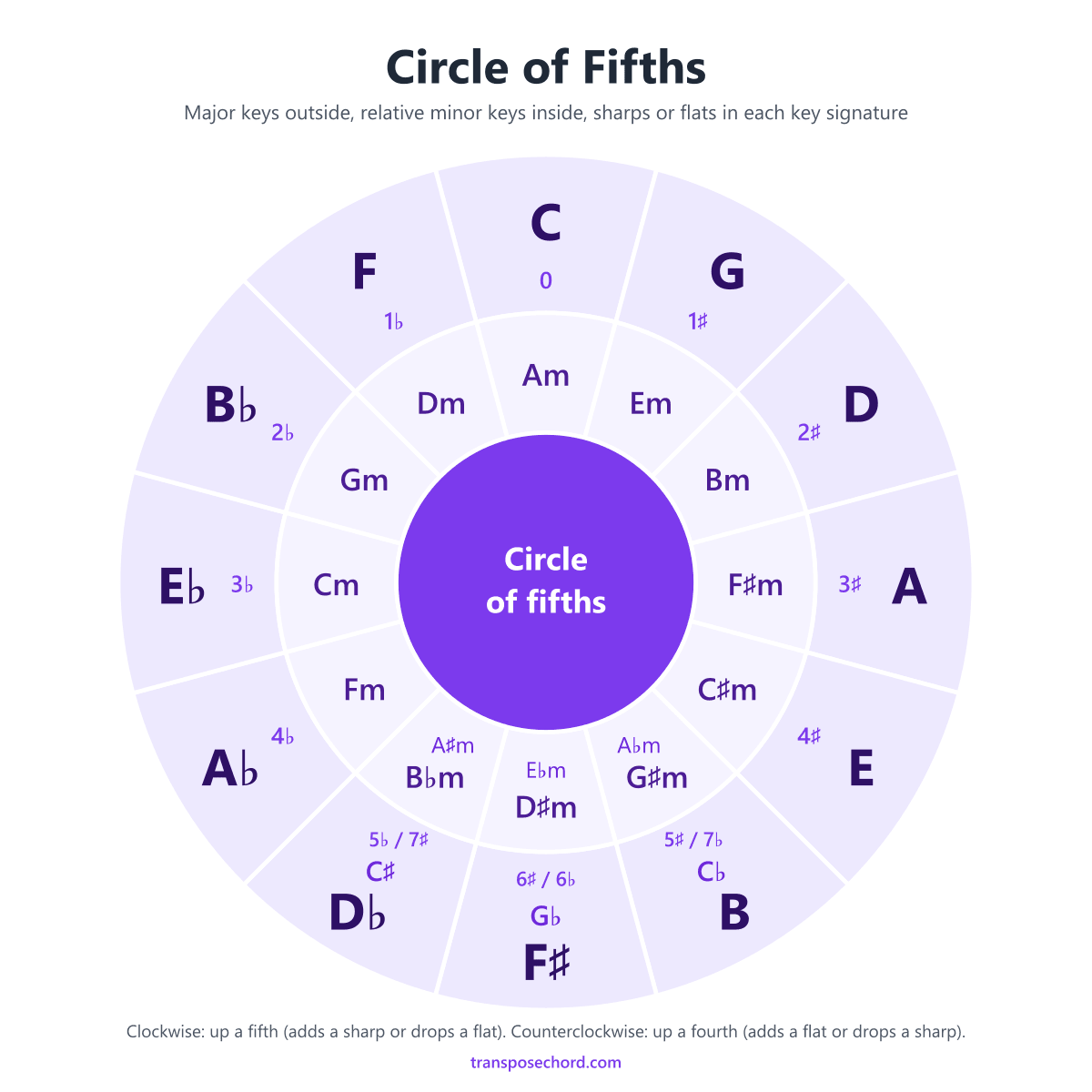
The circle of fifths is a diagram of all 12 major keys and their relative minors, arranged like a clock so that each key is a perfect fifth above the one before it. Going clockwise from C at the top, every step adds one sharp to the key signature; going counterclockwise, every step adds one flat. Keys next to each other share all but one note, which is why they sound related and why songs move between them so easily.
A perfect fifth is seven semitones: C up to G, G up to D, D up to A. Keep stepping up by fifths and you pass through all 12 notes before arriving back at C, which is what closes the line into a circle. You'll also see it called the circle of 5ths, the wheel of fifths or the circle of keys; they're all the same diagram.
For a guitarist, that one picture answers most of the questions a chord sheet raises. Which chords belong in this key? What's the relative minor? Why does this song have so many barre chords? Where does a capo take me? The rest of this guide shows how to read each answer off the circle, starting with an interactive version.
One step clockwise is up a fifth. One step counterclockwise is up a fourth. Everything else on the circle follows from that.
Interactive Circle of Fifths
Select any key. You'll see its key signature, its relative minor, its neighbours, all seven chords, and diagrams for the four chords most songs in that key use. The shaded wedges show the six-chord family the key is built from.
C major
- Key signature
- no sharps or flats
- Relative minor
- A minor
- Neighbours
- F (IV, counterclockwise) and G (V, clockwise)
- On guitar
- An open-chord key, no capo needed
| I | ii | iii | IV | V | vi | vii° |
|---|---|---|---|---|---|---|
| C | Dm | Em | F | G | Am | Bdim |
Tap or click any key, inner or outer ring. Shaded wedges are the chord family of the key you picked: I, IV and V outside, ii, vi and iii inside.
How to Read the Circle of Fifths
- Outer ring: major keys. C sits at the top with no sharps or flats.
- Clockwise: sharp keys. G has 1 sharp, D has 2, A has 3, E has 4, B has 5, F♯ has 6. Each is a fifth above the last.
- Counterclockwise: flat keys. F has 1 flat, B♭ has 2, E♭ has 3, A♭ has 4, D♭ has 5, G♭ has 6. Each is a fourth above the last.
- Inner ring: relative minors. Each minor key shares the key signature of the major key beside it: A minor with C, E minor with G, D minor with F.
- Bottom: enharmonic keys. Where the sharp side meets the flat side, three positions have two names for the same sound: B and C♭, F♯ and G♭, D♭ and C♯.
The small number in each wedge is how many sharps (♯) or flats (♭) the key signature has. Distance on the circle is a good measure of how related two keys are: neighbours differ by one note, and keys on opposite sides, such as C and F♯, share only two of their seven notes.
Key Signatures Chart: Sharps and Flats in Every Key
A key signature is the set of sharps or flats written at the start of every line of music, just after the clef. It tells you which notes are raised or lowered for the whole piece, so you don't have to mark every F♯ in a song in G. Read the signature and you know the key, or one of two keys: the major key and its relative minor share it.
There are 15 key signatures: C with none, seven with sharps and seven with flats. Three pairs sound identical (B/C♭, F♯/G♭ and C♯/D♭), which is how 15 signatures fit on a 12-position circle. Each major key's relative minor uses the same signature.
| Major key | Relative minor | Signature | Sharps or flats |
|---|---|---|---|
| C major | A minor | 0 | None |
| G major | E minor | 1♯ | F♯ |
| D major | B minor | 2♯ | F♯ C♯ |
| A major | F♯ minor | 3♯ | F♯ C♯ G♯ |
| E major | C♯ minor | 4♯ | F♯ C♯ G♯ D♯ |
| B major | G♯ minor | 5♯ | F♯ C♯ G♯ D♯ A♯ |
| F♯ major | D♯ minor | 6♯ | F♯ C♯ G♯ D♯ A♯ E♯ |
| C♯ major | A♯ minor | 7♯ | F♯ C♯ G♯ D♯ A♯ E♯ B♯ |
| F major | D minor | 1♭ | B♭ |
| B♭ major | G minor | 2♭ | B♭ E♭ |
| E♭ major | C minor | 3♭ | B♭ E♭ A♭ |
| A♭ major | F minor | 4♭ | B♭ E♭ A♭ D♭ |
| D♭ major | B♭ minor | 5♭ | B♭ E♭ A♭ D♭ G♭ |
| G♭ major | E♭ minor | 6♭ | B♭ E♭ A♭ D♭ G♭ C♭ |
| C♭ major | A♭ minor | 7♭ | B♭ E♭ A♭ D♭ G♭ C♭ F♭ |
- C major / A minor: no sharps or flats
- G major / E minor: 1 sharp (F♯)
- D major / B minor: 2 sharps (F♯ C♯)
- A major / F♯ minor: 3 sharps (F♯ C♯ G♯)
- E major / C♯ minor: 4 sharps (F♯ C♯ G♯ D♯)
- B major / G♯ minor: 5 sharps (F♯ C♯ G♯ D♯ A♯)
- F♯ major / D♯ minor: 6 sharps (F♯ C♯ G♯ D♯ A♯ E♯)
- C♯ major / A♯ minor: 7 sharps (F♯ C♯ G♯ D♯ A♯ E♯ B♯)
- F major / D minor: 1 flat (B♭)
- B♭ major / G minor: 2 flats (B♭ E♭)
- E♭ major / C minor: 3 flats (B♭ E♭ A♭)
- A♭ major / F minor: 4 flats (B♭ E♭ A♭ D♭)
- D♭ major / B♭ minor: 5 flats (B♭ E♭ A♭ D♭ G♭)
- G♭ major / E♭ minor: 6 flats (B♭ E♭ A♭ D♭ G♭ C♭)
- C♭ major / A♭ minor: 7 flats (B♭ E♭ A♭ D♭ G♭ C♭ F♭)
Sharp keys first, then flat keys (shaded). B and C♭, F♯ and G♭, and C♯ and D♭ sound the same; they are spelled differently.
Most guitar charts stay in the sharp keys up to E and the flat keys up to E♭ or A♭, and you'll almost never see C♭ or C♯ major. Seven sharps or seven flats is something you'll meet in a theory exam rather than on a chord sheet.
The Order of Sharps and Flats
Sharps and flats are always added to a key signature in the same order, and the order is the circle itself:
- Order of sharps: F♯ C♯ G♯ D♯ A♯ E♯ B♯. Remember it as Father Charles Goes Down And Ends Battle.
- Order of flats: B♭ E♭ A♭ D♭ G♭ C♭ F♭. The same letters backwards: Battle Ends And Down Goes Charles' Father.
So a key with three sharps always has the first three, F♯, C♯, G♯, never some other three. Two shortcuts name the key from its signature:
- Sharp keys: go up a half step from the last sharp. Three sharps ending on G♯ means A major.
- Flat keys: the second-to-last flat is the key. Three flats (B♭ E♭ A♭) means E♭ major. F major, with one flat, is the exception to memorise.
How to Find the Chords in Any Key
This is the most useful thing the circle does for a guitar player. A key's chords sit in a block of six: the key itself, its two neighbours, and the three minor keys inside them.
Take C at the top. Its neighbours are F (counterclockwise) and G (clockwise), so the three major chords in C are F, C and G: the IV, I and V. Directly inside them are Dm, Am and Em: the ii, vi and iii. That's six of the seven chords in the key. The seventh, Bdim, is the diminished chord, and it's rarely used in pop and folk.
The block slides with the key. Click D on the circle above and the block moves two steps clockwise: G, D and A outside, Em, Bm and F♯m inside. That is why songs in D lean on G and A, and why songs in A lean on D and E. Our Nashville number system chart lists all seven chords in every key, numbered, if you'd rather read them off a table.
Relative Minor Keys
Every major key has a relative minor: the minor key with the same key signature. It starts on the 6th note of the major scale, three semitones below the major key's name. On the circle it sits directly inside its major key: A minor inside C, E minor inside G, D minor inside F. Here are all twelve:
- C major: A minor
- G major: E minor
- D major: B minor
- A major: F♯ minor
- E major: C♯ minor
- B major: G♯ minor
- F♯ major: D♯ minor
- D♭ major: B♭ minor
- A♭ major: F minor
- E♭ major: C minor
- B♭ major: G minor
- F major: D minor
Their scales share notes too. A minor key's natural minor scale is its relative major's scale started on the 6th note: A natural minor is A B C D E F G, every note of C major and nothing else.
Relative keys use the same seven chords, just with a different home. The chords of E minor are G major's chords started on Em: Em F♯dim G Am Bm C D. A song that keeps returning to Em and feels dark is in E minor; one that settles on G and feels bright is in G major. Same chord shapes either way.
Don't confuse it with the parallel minor, which shares the key's name rather than its notes. C minor is the parallel minor of C major; it has three flats, and you'll find it inside E♭, three steps counterclockwise from C. Borrowing chords from the parallel minor (B♭ or A♭ in a song in C) is where many rock songs get their sound.
Chord Progressions and the Circle of Fourths
The strongest move in tonal music is a chord falling a fifth to the next: V to I, G to C. On the circle that is one step counterclockwise. Chain several of those steps together and you get the progressions jazz, gospel, soul and the Great American Songbook are built from:
| Progression | In C | In G | In D | In A |
|---|---|---|---|---|
| V–I | G C | D G | A D | E A |
| ii–V–I | Dm G C | Am D G | Em A D | Bm E A |
| vi–ii–V–I | Am Dm G C | Em Am D G | Bm Em A D | F♯m Bm E A |
| iii–vi–ii–V–I | Em Am Dm G C | Bm Em Am D G | F♯m Bm Em A D | C♯m F♯m Bm E A |
- V–I: One step counterclockwise: the strongest pull in tonal music.
- ii–V–I: Two steps counterclockwise. The backbone of jazz standards.
- vi–ii–V–I: Three steps: a common turnaround at the end of a verse or chorus.
- iii–vi–ii–V–I: Four steps, each root a fifth below the last.
Read counterclockwise, the circle is also called the circle of fourths, because each step up a fourth is the same note as a step down a fifth. Jazz players practise scales and chord changes in this direction for that reason. The bridge of Gershwin's "I Got Rhythm" runs D7 G7 C7 F7 before landing on B♭: four dominant sevenths, each a step counterclockwise from the last.
Rock goes the other way just as happily. "Hey Joe", as Jimi Hendrix recorded it, cycles C G D A E: five steps clockwise, landing on E. Played on guitar, that's five open chords in a row, because the open-chord keys sit next to each other on the circle.
The Circle of Fifths on Guitar
The five open-chord keys, C, G, D, A and E, are five neighbours at the top right of the circle. That's no accident. Open chords lean on the open strings, and the notes of the open strings, E A D G B, are themselves five neighbours on the circle: G, D, A, E and B. The further a key sits from that corner, the more barre chords it asks for: F and B♭ on one side, B and F♯ on the other. Our basic guitar keys guide ranks all 12 by how many barre chords they cost.
A capo moves you around the circle:
- Capo 7 moves every shape one step clockwise: G shapes sound in D, C shapes sound in G.
- Capo 5 moves every shape one step counterclockwise: G shapes sound in C, D shapes sound in G.
- Capo 2 moves every shape two steps clockwise, a whole step up: G shapes sound in A, C shapes in D.
The interactive circle above gives the lowest capo position for each key. The guitar capo chart lays out every fret and every shape. The guitar's tuning also follows the circle: the bottom four strings, E A D G, are four neighbours read counterclockwise, which is why the 5th fret of the low E, A and D strings gives you the next string's note.
For transposing, two steps clockwise is always a whole step up (C to D, G to A, F to G). A half step is less tidy: C to D♭ is five steps counterclockwise, nearly opposite C on the circle, which is exactly why moving a song up a half step changes almost every chord. That's also the job a transposer is for. Our guide to changing the key of a song for your voice covers how to choose the new key in the first place.
Skip the counting
The circle tells you where a song is going. To actually move a whole chord sheet there, lyrics included, paste it in and pick the new key:
Use TransposeChord →Printable Circle of Fifths Chart
For a music stand or a practice-room wall, here is the full circle on one page: major keys, relative minors, and the number of sharps or flats in each.
Circle of Fifths Questions, Answered
What is the circle of fifths?
The circle of fifths is a diagram of all 12 major keys and their relative minor keys, arranged like a clock so that each key is a perfect fifth (seven semitones) above the one before it, going clockwise. It shows how many sharps or flats each key has, which keys are closely related, and which chords belong together in a key.
How do you read the circle of fifths?
Start at C at the top, which has no sharps or flats. Each step clockwise goes up a fifth and adds one sharp: G has 1, D has 2, A has 3. Each step counterclockwise from C adds one flat: F has 1, B♭ has 2, E♭ has 3. The inner ring shows each major key’s relative minor, which shares its key signature.
Why is it called the circle of fifths?
Because each step clockwise moves up a perfect fifth, the interval from C to G. Twelve fifths pass through all 12 notes and land back on C (seven octaves higher), so the sequence closes into a circle.
What is the order of sharps?
The order of sharps is F♯ C♯ G♯ D♯ A♯ E♯ B♯, the same order as the keys clockwise around the circle. A common way to remember it is “Father Charles Goes Down And Ends Battle.” A key with two sharps always has the first two, F♯ and C♯.
What is the order of flats?
The order of flats is B♭ E♭ A♭ D♭ G♭ C♭ F♭, the order of sharps backwards. It is often remembered as “Battle Ends And Down Goes Charles’ Father.” A key with three flats always has the first three, B♭, E♭, A♭.
What is a key signature?
A key signature is the set of sharps or flats written at the start of every line of music, just after the clef. It tells you which notes are raised or lowered throughout the piece: a key signature of one sharp, F♯, means every F is played as F♯ unless an accidental says otherwise. Each key signature belongs to one major key and its relative minor.
How do you know how many sharps or flats a key has?
Count the steps from C. Each step clockwise adds a sharp, each step counterclockwise adds a flat. D is two steps clockwise, so it has 2 sharps (F♯ C♯); E♭ is three steps counterclockwise, so it has 3 flats (B♭ E♭ A♭). A shortcut for sharp keys: the key is a half step above its last sharp. For flat keys, the key is named by its second-to-last flat; F, with one flat, is the one to memorise.
What is the relative minor of a key?
The relative minor is the minor key that shares a major key’s key signature. It starts on the 6th note of the major scale, three semitones below the major key. The relative minor of C is A minor, of G is E minor, and of F is D minor. On the circle of fifths it sits directly inside its major key.
What is the relative minor of D major?
The relative minor of D major is B minor. B is the 6th note of the D major scale, and both keys share the same key signature: 2 sharps (F♯ C♯). The same rule gives the others: A major’s relative minor is F♯ minor, E major’s is C♯ minor, and G major’s is E minor.
What key has 3 flats?
The key with three flats (B♭, E♭, A♭) is E♭ major, or its relative minor, C minor. E♭ sits three steps counterclockwise from C on the circle of fifths, and the shortcut for flat keys gives the same answer: the second-to-last flat, E♭, names the major key.
How do you use the circle of fifths to find the chords in a key?
Find the key, then take its two neighbours and the three minor keys beneath those three. In G that gives the majors C, G and D (IV, I and V) and the minors Am, Em and Bm (ii, vi and iii). The seventh chord, F♯dim, is the diminished chord on the 7th note of the scale.
What is the circle of fourths?
It is the same circle read counterclockwise: C, F, B♭, E♭ and so on, each key a perfect fourth above the one before. Jazz musicians often practise in this direction because chord progressions such as ii–V–I and the bridge of “I Got Rhythm” (D7 G7 C7 F7 in B♭) move that way.
How do you use the circle of fifths on guitar?
The five easiest guitar keys, C, G, D, A and E, sit next to each other on the circle, so any song whose key is in that run can be played with open chords. A capo moves you around the circle: capo 7 moves any chord shape one step clockwise (G shapes sound in D), and capo 5 moves it one step counterclockwise (G shapes sound in C).
Who invented the circle of fifths?
The earliest known circle of fifths appears in Grammatika, a treatise on composition written in the late 1670s by the Kyiv-born composer and theorist Nikolay Diletsky. The German composer Johann David Heinichen published his own version in 1711 and a revised one in 1728, and the diagram has been a standard part of music theory teaching ever since.
Free tool
Know the key. Change it in one click.
Paste any chord sheet, move it around the circle to the key you need, and see the fingering for every chord.
transposechord.com →