

What the Nashville Number System Is
The Nashville Number System writes chords as numbers instead of letter names. Each number is a note of the song's major scale, so in the key of C, 1 is C, 4 is F, 5 is G and 6- is Am. Because the numbers describe a chord's place in the key rather than its pitch, one chart works in every key.
That's the whole trick, and it's why Nashville session players have used it for over sixty years. A singer walks in, asks for the song a whole step lower, and nobody rewrites anything. The chart still says 1 4 5. Everyone just plays it from a different starting note.
The system started in the late 1950s with Neal Matthews Jr. of the Jordanaires, who used numbers to chart vocal parts between back-to-back recording sessions. In the early 1960s, session harmonica player Charlie McCoy applied the idea to chords, and it became the everyday language of Nashville studios. Today you'll see number charts in country sessions, worship teams, function bands and anywhere a song might be called in a different key at short notice.
A chord name tells you what to play. A number tells you what the chord is doing — and that stays true in any key.
Nashville Number Chart: Chords in All 12 Keys
Every major key has the same seven chords in the same order: three major (1, 4, 5), three minor (2-, 3-, 6-) and one diminished (7°). Only the letter names change from key to key. Find your key on the left and read across. Under each number is its Roman numeral, the music-theory name for the same chord.
| Key | 1I | 2-ii | 3-iii | 4IV | 5V | 6-vi | 7°vii° |
|---|---|---|---|---|---|---|---|
| Key of C | C | Dm | Em | F | G | Am | Bdim |
| Key of D♭ | D♭ | E♭m | Fm | G♭ | A♭ | B♭m | Cdim |
| Key of D | D | Em | F♯m | G | A | Bm | C♯dim |
| Key of E♭ | E♭ | Fm | Gm | A♭ | B♭ | Cm | Ddim |
| Key of E | E | F♯m | G♯m | A | B | C♯m | D♯dim |
| Key of F | F | Gm | Am | B♭ | C | Dm | Edim |
| Key of F♯ | F♯ | G♯m | A♯m | B | C♯ | D♯m | E♯dim |
| Key of G | G | Am | Bm | C | D | Em | F♯dim |
| Key of A♭ | A♭ | B♭m | Cm | D♭ | E♭ | Fm | Gdim |
| Key of A | A | Bm | C♯m | D | E | F♯m | G♯dim |
| Key of B♭ | B♭ | Cm | Dm | E♭ | F | Gm | Adim |
| Key of B | B | C♯m | D♯m | E | F♯ | G♯m | A♯dim |
- Numbers: 1 2- 3- 4 5 6- 7°Roman numerals: I ii iii IV V vi vii°
- Key of C: C Dm Em F G Am Bdim
- Key of D♭: D♭ E♭m Fm G♭ A♭ B♭m Cdim
- Key of D: D Em F♯m G A Bm C♯dim
- Key of E♭: E♭ Fm Gm A♭ B♭ Cm Ddim
- Key of E: E F♯m G♯m A B C♯m D♯dim
- Key of F: F Gm Am B♭ C Dm Edim
- Key of F♯: F♯ G♯m A♯m B C♯ D♯m E♯dim
- Key of G: G Am Bm C D Em F♯dim
- Key of A♭: A♭ B♭m Cm D♭ E♭ Fm Gdim
- Key of A: A Bm C♯m D E F♯m G♯dim
- Key of B♭: B♭ Cm Dm E♭ F Gm Adim
- Key of B: B C♯m D♯m E F♯ G♯m A♯dim
Shaded rows are the five open-chord guitar keys. Read across for a key, or down a column to see one number in every key.
For example, the chords in the key of G are G, Am, Bm, C, D, Em and F♯dim: 1 through 7°, or I ii iii IV V vi vii°. The three majors, G, C and D, are the 1 4 5, and adding Em gives you the four chords behind most songs played in G.
Read down a column instead and you get a useful pattern: the 4 and 5 chords of any key are its two neighbours on the circle of fifths. In G, 4 is C and 5 is D. In D, they're G and A. Learn the 1 4 5 of the five shaded keys and you can play most country, folk and rock songs ever written. Our guide to basic guitar keys ranks all 12 by how many barre chords they cost.
How to Number Any Song
Turning a chord sheet into a number chart takes four steps:
- 1Find the key. The song usually starts or ends on its home chord, and that chord is usually the one that feels like resolution. If a sheet lists a key, use it.
- 2Find that key’s row in the chart above. Those seven chords are your 1 through 7.
- 3Swap each chord for its number, keeping the quality: Em in the key of G becomes 6-, D7 becomes 57.
- 4Write one number per bar. Two chords in a bar get grouped together, and any chord not in the row gets a ♭ or ♯ — F in the key of G is ♭7.
Take a verse in G: G D Em C. G is the key chord, so it's 1. D is the 5th chord in the row, Em the 6th, C the 4th. The verse is 1 5 6- 4, which is exactly what the converter below opens with.
Convert Chords to Numbers (and Back)
Pick the song's key, then type numbers or chords. You'll get both versions, chord diagrams for the key you chose, and the same progression in all 12 keys. Tap any key in the list to switch to it.
As numbers
1 5 6- 4
As chords in G
G D Em C
The same numbers in every key
- C G Am F
- D♭ A♭ B♭m G♭
- D A Bm G
- E♭ B♭ Cm A♭
- E B C♯m A
- F C Dm B♭
- F♯ C♯ D♯m B
- G D Em C
- A♭ E♭ Fm D♭
- A E F♯m D
- B♭ F Gm E♭
- B F♯ G♯m E
A plain number is always a major chord — write 6- or 6m for minor. Altered numbers like ♭7 take the nearest common spelling.
Try typing 2- 5 1 and stepping through the keys, or paste the chords from a song you know and see which numbers come out. Slash chords (G/B), sevenths (D7) and borrowed chords (B♭ in G) all convert.
How to Read Nashville Charts: The Symbols
A real number chart carries more than numbers. In 4/4, each number is one bar unless marked otherwise, and a handful of symbols cover chord quality and rhythm. Exact conventions vary a little between studios, but these are the common ones:
| Symbol | Meaning |
|---|---|
| 1 | A major chord built on that note of the scale. A number on its own is always major. |
| 6- or 6m | Minor chord. In the key of C, 6- is A minor. |
| 7° | Diminished chord. In the key of C, 7° is B diminished. |
| 7ø | Half-diminished (m7♭5). In the key of C, 7ø is Bm7♭5. |
| 57 | Dominant seventh, usually with the 7 written small and raised. In the key of C, 57 is G7. |
| 1Δ7 or 1maj7 | Major seventh. In the key of C, 1Δ7 is Cmaj7. |
| 1/3 | Slash chord: the 1 chord with the 3rd note of the key in the bass. In the key of C, 1/3 is C/E. |
| ♭7 | A major chord on the lowered 7th note — B♭ in the key of C, F in the key of G. |
| ◇ (diamond) | Hit the chord once and let it ring for the bar. |
| Underlined group | Several chords sharing one bar, split evenly unless marked otherwise. |
Sections are labelled the usual way (V for verse, C for chorus, B for bridge), and a chart is usually written as one line per phrase so you can see the shape of the song at a glance.
Common Chord Progressions: 1 4 5, 1 5 6 4 and More
Numbers make it obvious how much music shares the same few progressions. These six cover a huge share of popular songs, shown in the five open-chord guitar keys with their Roman numerals underneath. Outside Nashville charts the dash is often dropped, so the 1 5 6 4 chord progression is the same thing as 1 5 6- 4: the 6 is minor either way.
| Numbers | In C | In G | In D | In A | In E |
|---|---|---|---|---|---|
| 1 4 5I IV V | C F G | G C D | D G A | A D E | E A B |
| 1 5 6- 4I V vi IV | C G Am F | G D Em C | D A Bm G | A E F♯m D | E B C♯m A |
| 1 6- 4 5I vi IV V | C Am F G | G Em C D | D Bm G A | A F♯m D E | E C♯m A B |
| 1 4 6- 5I IV vi V | C F Am G | G C Em D | D G Bm A | A D F♯m E | E A C♯m B |
| 6- 4 1 5vi IV I V | Am F C G | Em C G D | Bm G D A | F♯m D A E | C♯m A E B |
| 2- 5 1ii V I | Dm G C | Am D G | Em A D | Bm E A | F♯m B E |
- 1 4 5 (I IV V): The three-chord song: country, blues, folk, early rock and roll.
- 1 5 6- 4 (I V vi IV): The pop progression — "Let It Be" (in C) and "With or Without You" (in D).
- 1 6- 4 5 (I vi IV V): The ’50s progression — "Stand by Me" (in A).
- 1 4 6- 5 (I IV vi V): The pop chords reordered to save the 5 for last, so each pass pulls straight back to the 1.
- 6- 4 1 5 (vi IV I V): The same four pop chords started on the minor, for a darker feel.
- 2- 5 1 (ii V I): The ii–V–I of jazz, also common in gospel and worship music.
The 1 4 5 shows up again in the twelve-bar blues, which is 1 4 5 arranged over twelve bars. Our 12-bar blues chords in every key lays out the full form.
Transposing With Numbers
Transposing a number chart takes no work at all: change the key at the top. 1 5 6- 4 is G D Em C in G and A E F♯m D in A. Nothing on the chart moves.
That's also the fastest way to transpose in your head. Instead of shifting each letter up two semitones, ask "what number is this chord?" and then "what's that number in the new key?" After a few songs, you stop thinking in letters for the common chords.
On guitar there's a second route: keep the numbers and the shapes, and let a capo change the key. Play 1 4 5 with G shapes and capo 2, and it sounds in A. The guitar capo chart shows which capo fret reaches each key, and changing a song's key for your voice covers how to pick the key in the first place.
Chord sheet, not numbers?
Most chord sheets online are written with letter names. Paste the whole thing — lyrics included — and shift it to any key in one click:
Use TransposeChord →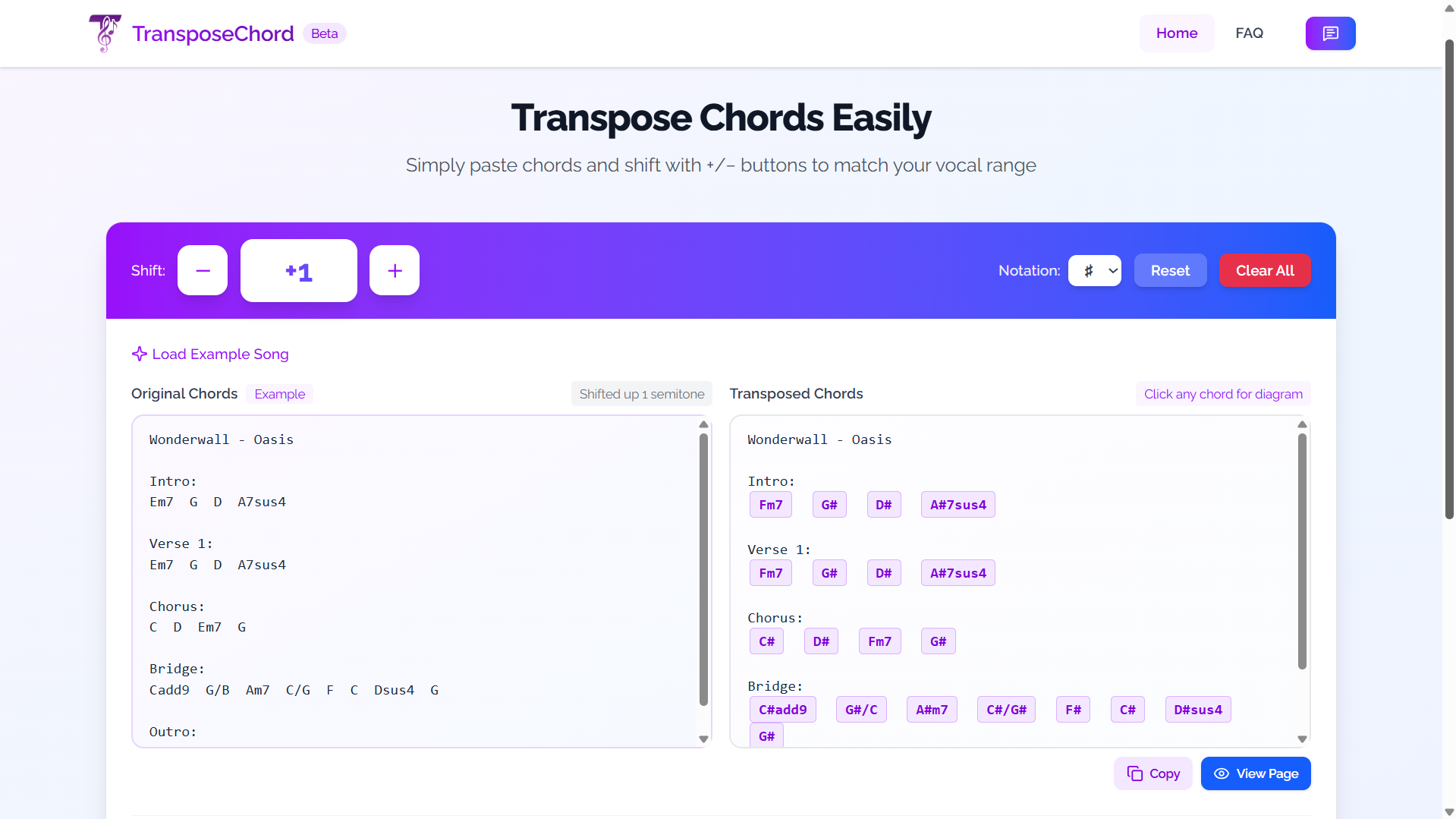
Minor Keys: 1- or 6-? (and Minor Roman Numerals)
Minor-key songs are the one place number charts disagree. Take a song in A minor using Am, Dm, Em and F:
- Relative major (the traditional Nashville way): chart it in C, the relative major of A minor. The chords become 6- 2- 3- 4. The home chord is 6-.
- Minor as 1: chart it from A, so the chords become 1- 4- 5- ♭6. The home chord is 1-, which some players find easier to read.
Neither is wrong. Write the key and which system you're using at the top of the chart, and anyone can read it.
Here are all seven chords of A minor in both numberings, with the Roman numerals music theory uses for the minor scale. Lowercase is minor, uppercase is major and ° is diminished:
| Chord in A minor | Am | Bdim | C | Dm | Em | F | G |
|---|---|---|---|---|---|---|---|
| Roman numeral | i | ii° | III | iv | v | VI | VII |
| Numbers from C (6-) | 6- | 7° | 1 | 2- | 3- | 4 | 5 |
| Numbers from A (1-) | 1- | 2° | ♭3 | 4- | 5- | ♭6 | ♭7 |
One common change: many minor songs swap the minor v for a major V, here E or E7 instead of Em, because the major chord pulls back to the home chord harder. On a chart that's 3 (from C) or 5 (from A), with no dash.
Nashville Number Questions, Answered
What is the Nashville Number System?
The Nashville Number System is a way of writing chord charts with numbers instead of chord names. Each number is a note of the song’s major scale: 1 is the key chord, 4 and 5 are the other two major chords, and 2-, 3- and 6- are the minor chords. Because the numbers are relative to the key, the same chart works in any key without being rewritten.
What chords are in the key of G?
The key of G major has seven chords: G (1), Am (2-), Bm (3-), C (4), D (5), Em (6-) and F♯dim (7°). In Roman numerals they are I ii iii IV V vi vii°. G, C and D are the three major chords, and most songs in G use mainly those three plus Em.
What is the 1 4 5 chord progression?
1 4 5 (I IV V in Roman numerals) uses the three major chords of a major key, built on its 1st, 4th and 5th notes. In C they are C F G; in G, G C D; in D, D G A; in A, A D E; and in E, E A B.
What is the 1 5 6 4 chord progression?
It is the four-chord pop progression, written 1 5 6- 4 on a Nashville chart or I V vi IV in Roman numerals; the 6 is always minor. In C it is C G Am F, and in G it is G D Em C.
How do you write a minor chord in the Nashville Number System?
Put a dash or a lowercase m after the number: 6- or 6m. A number on its own always means a major chord, so 6 in the key of C is A major, not A minor.
How do you transpose with Nashville numbers?
You don’t change the chart — only the key at the top. A chart reading 1 4 5 is G C D in the key of G; if the singer wants A, the same chart is played as A D E.
Is the Nashville Number System the same as Roman numeral analysis?
It is the same idea with different notation. Roman numerals (I, ii, V7) come from music theory and show major or minor by upper and lower case. Nashville charts use ordinary numbers, mark minor with a dash, and add rhythm symbols for session players, such as one number per bar and a diamond for a chord that rings.
How do you number a song in a minor key?
There are two conventions. Most Nashville players number from the relative major, so a song in A minor is charted in C and its home chord is 6-. Others call the minor home chord 1-. Both work; write which one you are using at the top of the chart.
What are the Roman numerals for a minor key?
In a natural minor key the chords are i ii° III iv v VI VII: minor on 1, 4 and 5, diminished on 2, and major on 3, 6 and 7. In A minor that is Am Bdim C Dm Em F G. Many minor songs also raise the v to a major V (E or E7 in A minor) for a stronger pull home.
Who invented the Nashville Number System?
Neal Matthews Jr. of the Jordanaires, the vocal group behind many Elvis Presley records, devised it in the late 1950s to chart vocal parts quickly. In the early 1960s, session harmonica player Charlie McCoy applied it to chords for the rhythm section, and it spread through Nashville’s studios from there.
Free tool
Numbers in your head. Chords on the page.
Paste any chord sheet, move it to the key you need, and see the fingering for every chord you land on.
transposechord.com →